Developing Yourkln: Crafting the Future of AI Conversations

20/07/2024 —Yourkln an emerging AI generation model, currently in its early phases of development, designed specifically to discuss and provide insights on a wide range of AI-related topics.
In the ever-evolving landscape of artificial intelligence, developing a model that can discuss and provide insights on a wide array of AI-related topics is both a challenging and exciting endeavor.
Enter Yourkln, an emerging AI generation model that is currently in its early phases of development. This blog will take you through the journey of creating Yourkln, highlighting the technical nuances and the vision behind this innovative project.
The Genesis of Yourkln
Yourkln was conceived out of a need for a specialized AI that could engage in detailed and insightful discussions on AI topics. With the rapid advancements in AI technology, there is a growing demand for models that not only understand the technicalities but can also articulate complex concepts in an accessible manner. Yourkln aims to fill this niche by being a reliable source of information and insights on all things AI.
The Backbone: LLaMA-3 8B Model
At the heart of Yourkln lies the LLaMA-3 8B model, a robust foundation known for its efficiency and performance in natural language processing tasks. The decision to fine-tune Yourkln from the LLaMA-3 8B model was strategic, leveraging its capabilities to build a model that can handle the complexity of AI discussions.
The Training Process
Training Yourkln involved using an NVIDIA A100 Tensor Core GPU, one of the most powerful GPUs available for AI training. This GPU's high performance and efficiency made it possible to handle the extensive computations required for training such a sophisticated model. The training dataset comprised a vast range of renowned and paid AI books, ensuring that Yourkln had access to high-quality, authoritative information. These sources provided a wealth of knowledge, from foundational concepts to the latest advancements in AI.
Fine-tuning Yourkln was a meticulous process, aimed at honing its ability to discuss AI topics with depth and accuracy. This phase involved iterative training and evaluation, constantly refining the model's parameters to improve its performance. By focusing on high-quality AI literature, I ensured that Yourkln's responses are well-informed and reliable.
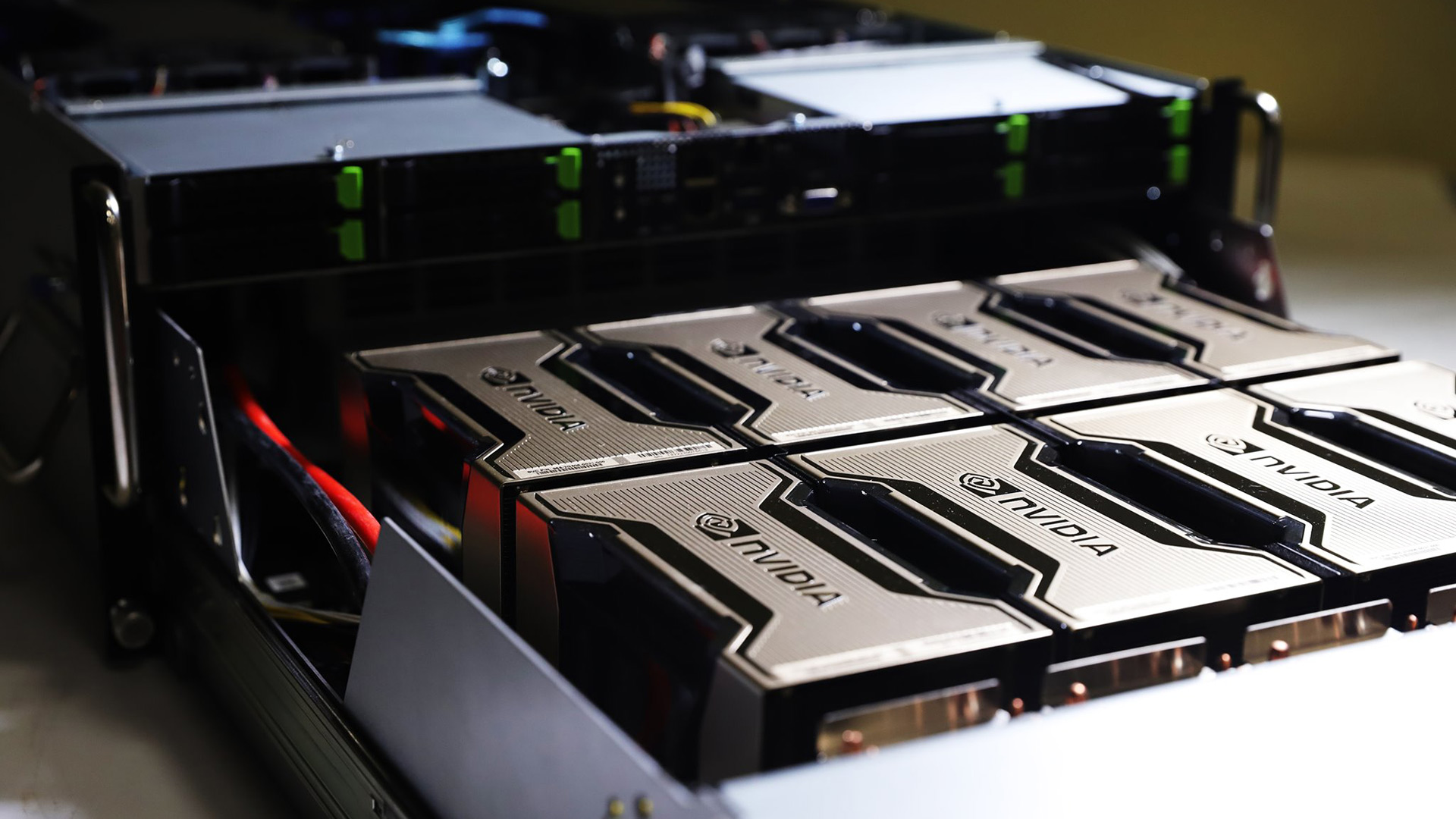
A server rack containing several NVIDIA A100 Tensor Core GPUs
Overcoming Challenges
The development of Yourkln was not without its challenges. One significant hurdle was ensuring that the model could generalize well across various AI topics while maintaining depth in its responses. This required careful selection of training materials and fine-tuning techniques to balance breadth and depth of knowledge. I am currently focused on reducing hallucinations—instances where the AI generates information that is incorrect or not based on the training data. This common challenge in AI models requires careful calibration. By using authoritative sources and implementing rigorous testing protocols, I strive to ensure that Yourkln provides accurate and reliable information.
The Vision
Yourkln is still in its early stages, but the potential it holds is immense. As it continues to evolve, the goal is to make it a go-to resource for anyone seeking insights into AI. Whether you're a student, a researcher, or an AI enthusiast, Yourkln aims to provide valuable information tailored to your needs.
In the future, I envision Yourkln expanding its capabilities, incorporating more diverse sources of information, and continuously improving its conversational abilities. The journey of developing Yourkln is ongoing, with each phase bringing new learnings and advancements.
Try Yourkln Today!
I'm excited to share Yourkln with you. Visit Yourkln to try the model and experience its capabilities firsthand. Your feedback will be invaluable as I continue to refine and improve Yourkln.
Comments
Leave a comment
Latest posts

Figure of the month
 Yann LeCun is a French computer scientist known for pioneering convolutional neural networks (CNNs), essential in modern AI applications. He is a professor at NYU and the Chief AI Scientist at Meta, receiving the Turing Award in 2018 for his contributions to deep learning.